Oracles and Benchmarks#
A Monte Carlo estimate is only trustworthy if you can check it. mcframework makes
“converges to a known answer” a first-class, repeatable operation: when a simulation
has a closed-form answer, it declares that answer as an oracle, and
validate_convergence() asserts the estimate lands on it.
The idea: oracle = checkable ground truth#
An oracle is a value you already know to be correct: the analytic expectation of a single draw. If the Monte Carlo mean does not converge to the oracle, the estimator is wrong — full stop. This turns correctness into a test instead of a vibe.
mcframework reuses machinery it already has. The oracle is passed straight through to
the stats engine as the context target (via run(extra_context={"target": oracle})),
which also populates bias_to_target / mse_to_target for free. Validation is a thin
pass/fail layer over the confidence interval the engine already computes.
Two complementary checks are reported:
within_ci— the oracle lies inside the computed confidence interval.within_tol— the absolute error is withinsigma_tolstandard errors:
\left| \widehat{\theta}_n - \theta \right| \le k \cdot \mathrm{SE},
\qquad \mathrm{SE} = \frac{s}{\sqrt{n}}, \quad k = \texttt{sigma\_tol}.
within_tol at a fixed seed is the recommended CI gate: it is statistically principled,
essentially never flaky (a \(5\sigma\) false failure is a ~1-in-1.7-million event), yet a real
implementation bug lands many standard errors away and fails loudly.
Quick start#
from mcframework import validate_convergence, BlackScholesSimulation

report = validate_convergence(BlackScholesSimulation(), 50_000, seed=0, option_type="call")
print(report.status)      # "pass"
print(report.estimate)    # Monte Carlo price
print(report.oracle)      # closed-form Black-Scholes-Merton price
print(report.abs_error)   # within a few standard errors
If a simulation declares no oracle, no run is performed and status is "no-oracle" —
a deliberate signal that the simulation is research, not a verifiable demo:
report = validate_convergence(BlackScholesSimulation(), 1_000, exercise_type="american")
assert report.status == "no-oracle"   # American options have no closed form
Built-in oracles#
These ship validated and are pinned by tests/test_oracles.py:
Simulation |
Oracle |
Reference |
|---|---|---|
\(\pi\) |
Closed form: \(4\,\Pr(X^2+Y^2\le 1)=\pi\) |
|
|
\(V_0 e^{\mu T}\) |
Risk-neutral GBM expectation |
\(S_0 e^{rT}\) |
Risk-neutral GBM terminal price |
|
|
\(C, P\) |
Black-Scholes-Merton (1973) |
|
none |
No closed form → not validated |
The Black-Scholes-Merton closed form for a European option is
C = S_0\,\Phi(d_1) - K e^{-rT}\,\Phi(d_2), \qquad
P = K e^{-rT}\,\Phi(-d_2) - S_0\,\Phi(-d_1),
with \(d_1 = \dfrac{\ln(S_0/K) + (r + \tfrac12\sigma^2)T}{\sigma\sqrt T}\) and \(d_2 = d_1 - \sigma\sqrt T\).
Adding an oracle to your own simulation#
Override analytic_reference() to return the
known expected value of a single draw under the given parameters, and set
reference_source to cite it. Return None when no oracle exists.
import math
from mcframework import MonteCarloSimulation, validate_convergence

class CoinFlipSimulation(MonteCarloSimulation):
    reference_source = "Closed form: E[Bernoulli(p)] = p"

    def __init__(self, p: float = 0.5):
        super().__init__("Coin Flip")
        self.p = p

    def single_simulation(self, _rng=None, **kwargs):
        rng = self._rng(_rng, self.rng)
        return float(rng.random() < self.p)

    def analytic_reference(self, **params):
        return self.p

report = validate_convergence(CoinFlipSimulation(0.3), 100_000, seed=0)
assert report.status == "pass"
analytic_reference receives the same keyword parameters as run / single_simulation,
so the oracle can depend on configuration (strike, drift, etc.). Keep the reference a
genuine closed form or a cited benchmark — never a second Monte Carlo estimate.
Kinds of reference#
Not every credible reference is a closed form. Set reference_kind to record which
flavour of ground truth you are checking against; it is surfaced on every
ConvergenceReport:
|
Meaning |
Example |
|---|---|---|
|
An exact analytic answer |
Black-Scholes-Merton price; \(V_0 e^{\mu T}\) |
|
A published, cited reference value |
A criticality benchmark \(k_\text{eff}\) from a standard suite |
|
A known asymptotic / limiting value |
A large-\(n\) or zero-variance limit |
A "benchmark" reference lets a domain simulation be validated even when no closed form
exists: analytic_reference returns the published constant and reference_source
carries the citation. The validation machinery is identical — only the provenance of the
oracle differs.
Promoting a simulation out of draft#
Rule: a simulation may not leave draft status (be advertised as production-ready, added to the built-in gallery, or recommended in docs) until it has either an analytic oracle or a cited benchmark, wired through
analytic_referenceand pinned by a convergence test intests/test_oracles.py.
This is the governance signal the whole system exists to provide. A simulation with no
checkable ground truth is research: keep analytic_reference returning None (its
reports read no-oracle) and label it as draft until a reference exists.
Benchmark template#
When there is no closed form, validate against a published benchmark in three steps:
Cite the source. Put the full reference in
reference_sourceand setreference_kind = "benchmark".Reproduce the value. Have
analytic_referencereturn the published constant for the matching parameters (andNonefor any configuration the benchmark does not cover).Show convergence. Add a
tests/test_oracles.pycase assertingvalidate_convergence(...).within_tolat a fixed seed, and (optionally) add the sim to the convergence gallery.
Worked example: reactor-physics criticality (not implemented here)#
A neutron-transport simulation has no elementary closed form, but the field publishes criticality benchmarks — configurations with an accepted reference \(k_\text{eff}\) (e.g. the ICSBEP handbook, or an analytic infinite-medium \(k_\infty = \nu\Sigma_f / \Sigma_a\)). The pattern would be:
class CriticalityBenchmarkSim(MonteCarloSimulation):
    reference_source = "ICSBEP HEU-MET-FAST-001 (Godiva), k_eff = 1.0000 +/- 0.0010"
    reference_kind = "benchmark"

    def analytic_reference(self, *, config="godiva", **params):
        return 1.0000 if config == "godiva" else None  # only the cited config

    def single_simulation(self, _rng=None, **kwargs):
        ...  # neutron transport estimating k_eff
mcframework ships no neutron-transport implementation: that remains a separate
domain effort. What it now provides is the gate — such a simulation is only credible
once its k_eff estimate is shown to converge to the cited benchmark.
The convergence gallery#
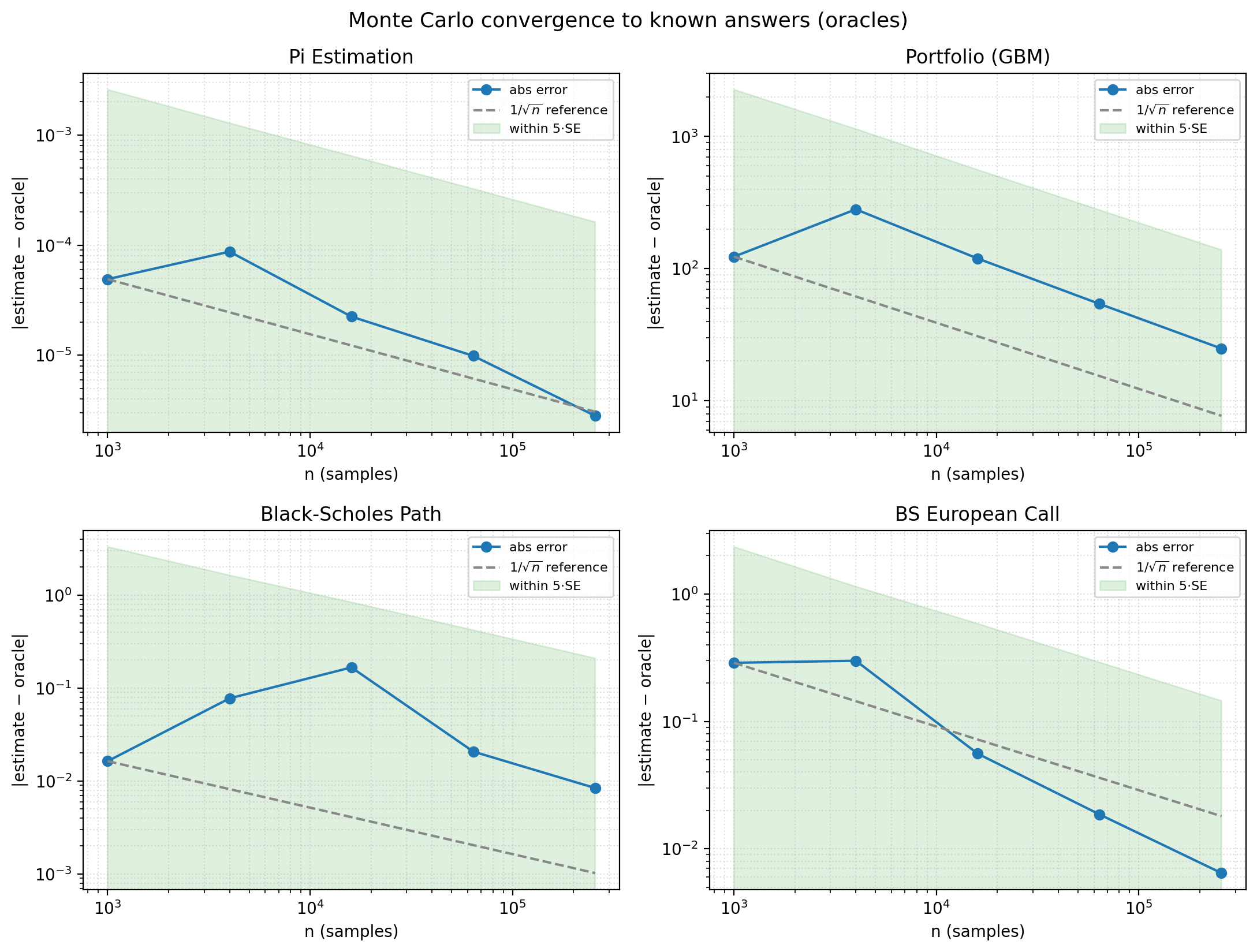
demos/demo_convergence_gallery.py sweeps every oracle-backed simulation over
increasing sample sizes and renders the result two ways: a Markdown convergence table
and a log-log error-vs-n plot. The absolute error tracks the theoretical
\(1/\sqrt{n}\) rate and stays inside the 5·SE pass band — correctness you can see.
# Full sweep (interactive), or headless with a saved figure:
python demos/demo_convergence_gallery.py
MPLBACKEND=Agg python demos/demo_convergence_gallery.py --quick --save gallery.png
See also
Validation Module for the full API reference.